


Nobody Wants a Data Centre Next Door. So We're Sending Them to Space.
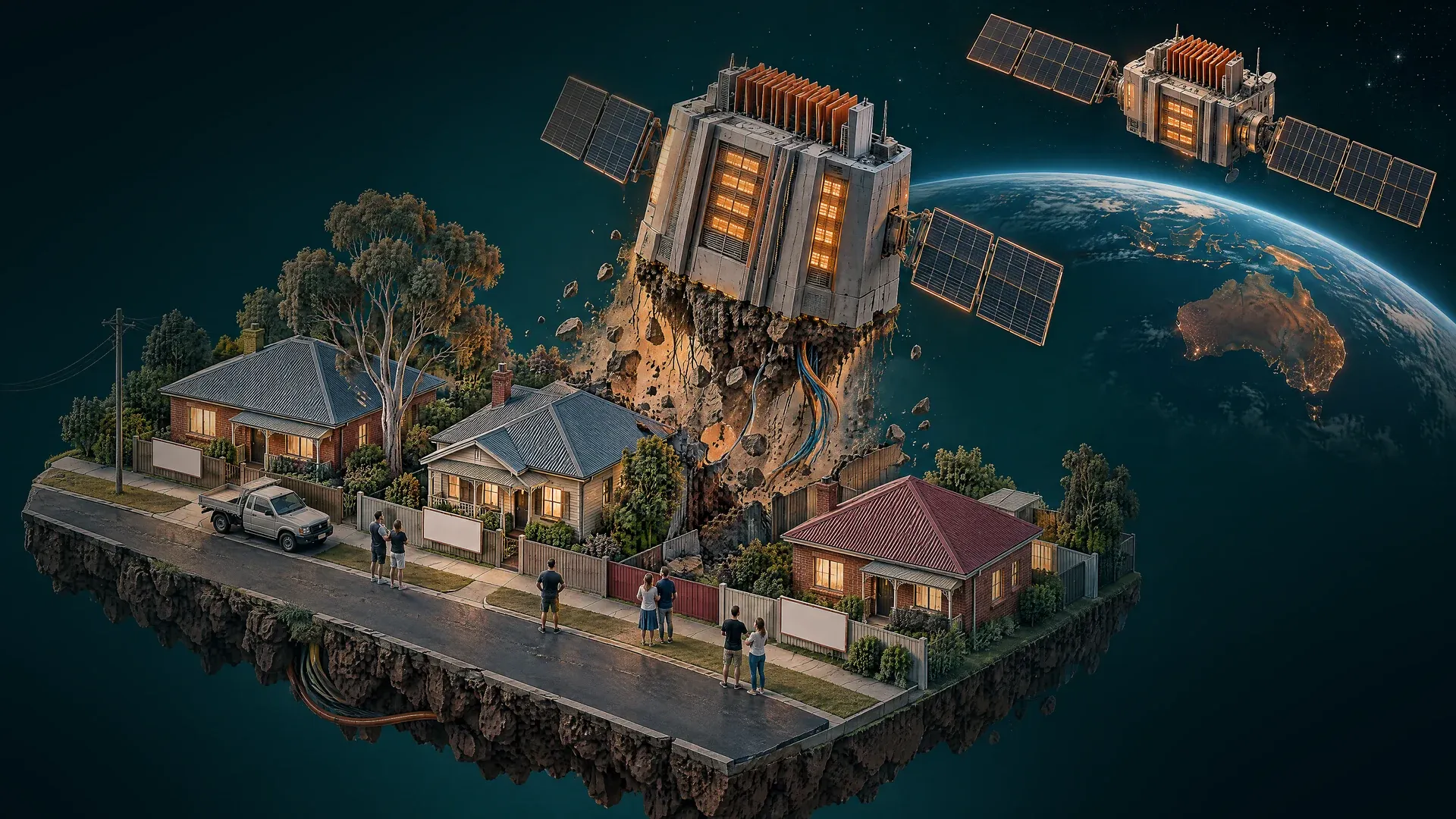
Everyone uses AI. Nobody wants its buildings.
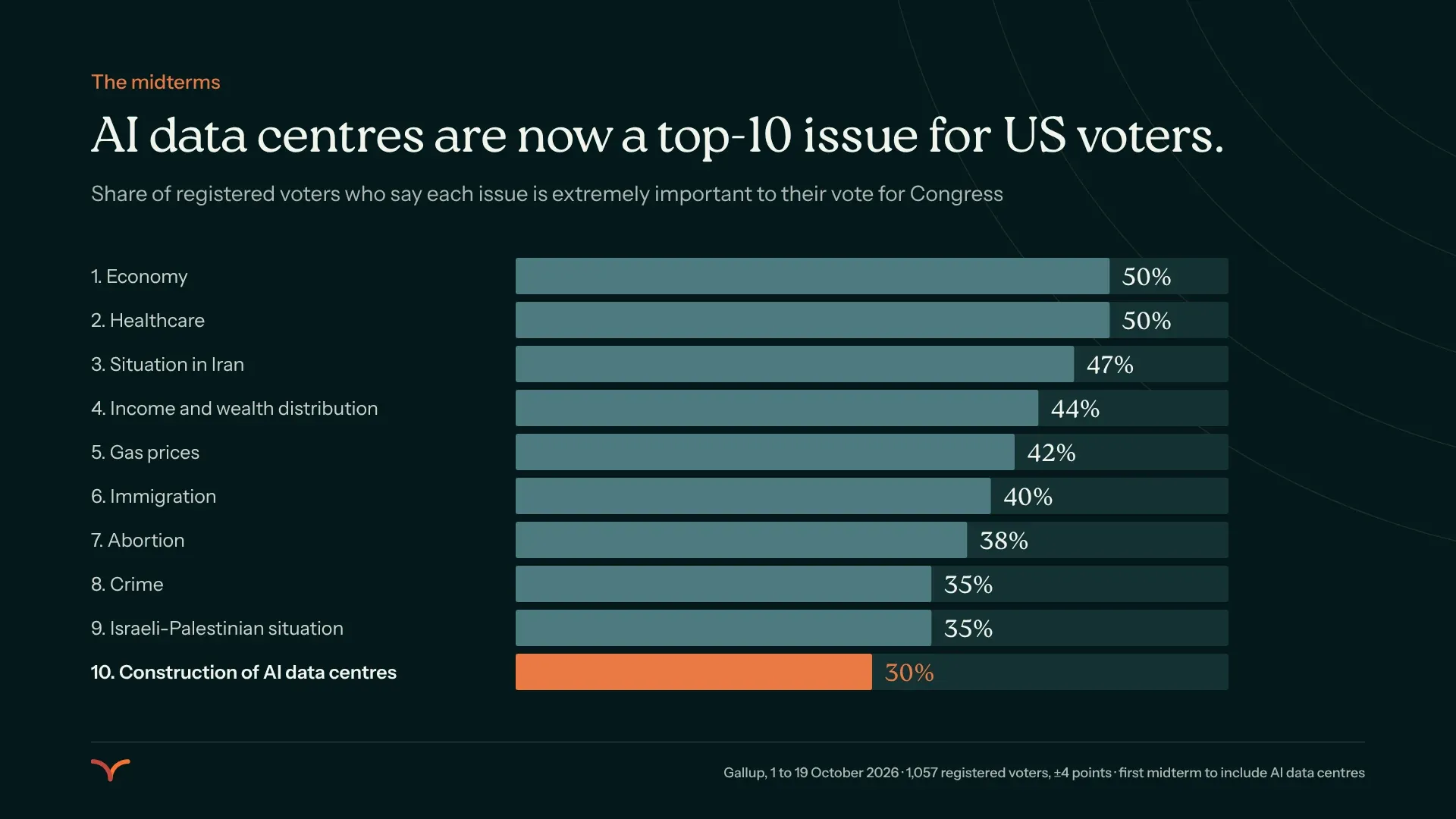
I've been reading the polls coming out of the US midterms, and one number keeps coming up. Nearly two in three American voters say they're less likely to back a candidate who supports a data centre in their town. Data centres, of all things, have become an election issue.
That's intriguing, because the same voters use AI every day. It worded their kid's party invitation, planned their next holiday and summarised the 40-page deck the boss sent at 6pm. Their favourite cafe used it to promote this morning's breakfast bundle. Every one of those requests went to a data centre, and the people sending them don't want one anywhere near their street.
So we love what AI does and we're fighting to keep its factories out of our postcodes. My argument in this piece is that the way out of that bind is to take the factories off the planet altogether. The companies doing it belong to a category most people haven't heard of yet, and we at Meliora call it Orbital Tech.
Here's what's in this piece: what this week's US midterm polls say about data centres, how a data centre works, why compute keeps the best AI tools in America, what Google did to a Finnish forest, why we wouldn't sink servers in the ocean, my plan for Australia's old mines, the race to put compute in orbit, three orbital-tech companies to remember, and a hot take you can argue with me about.
US Midterms: Nobody wants one next door
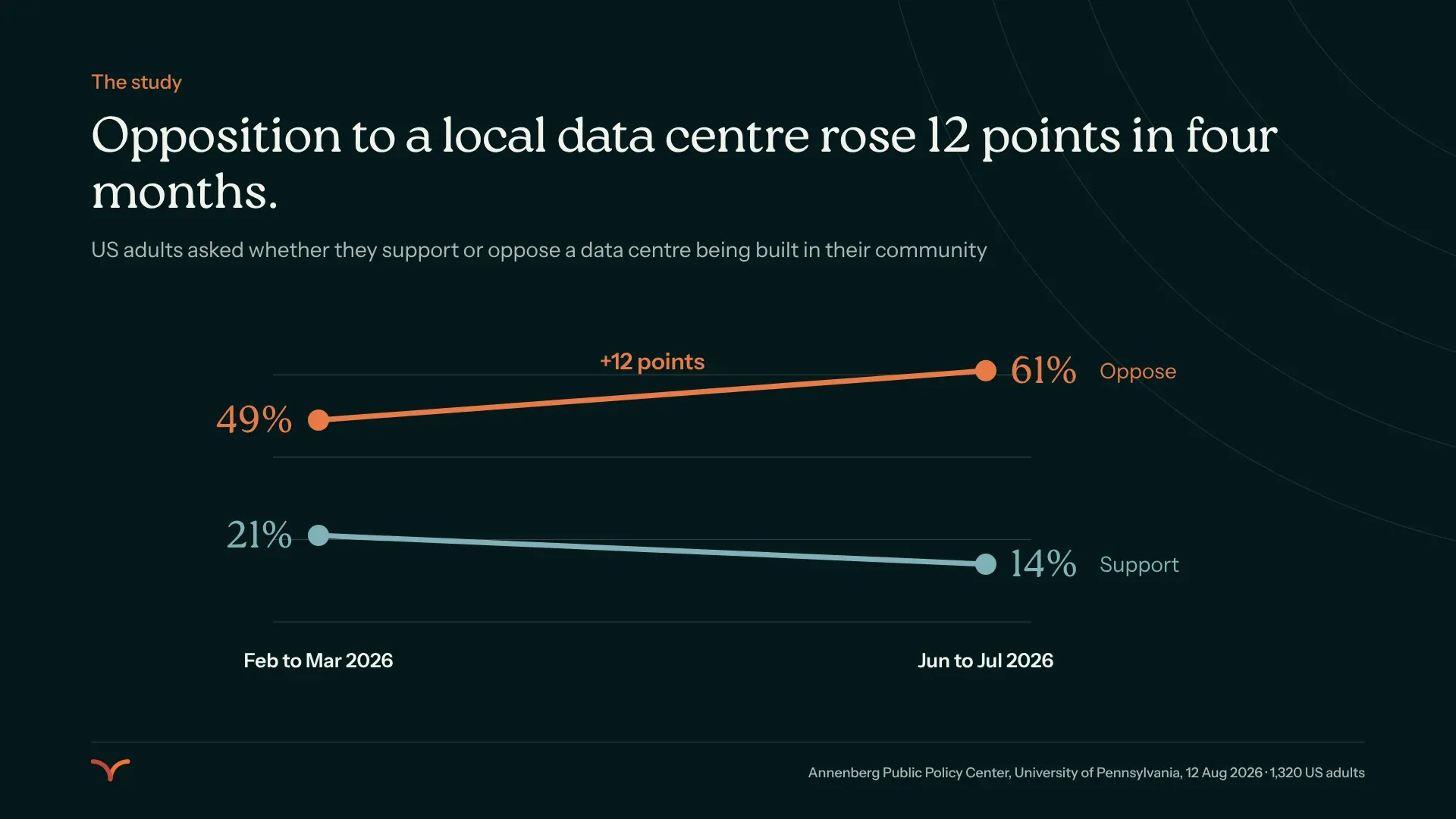
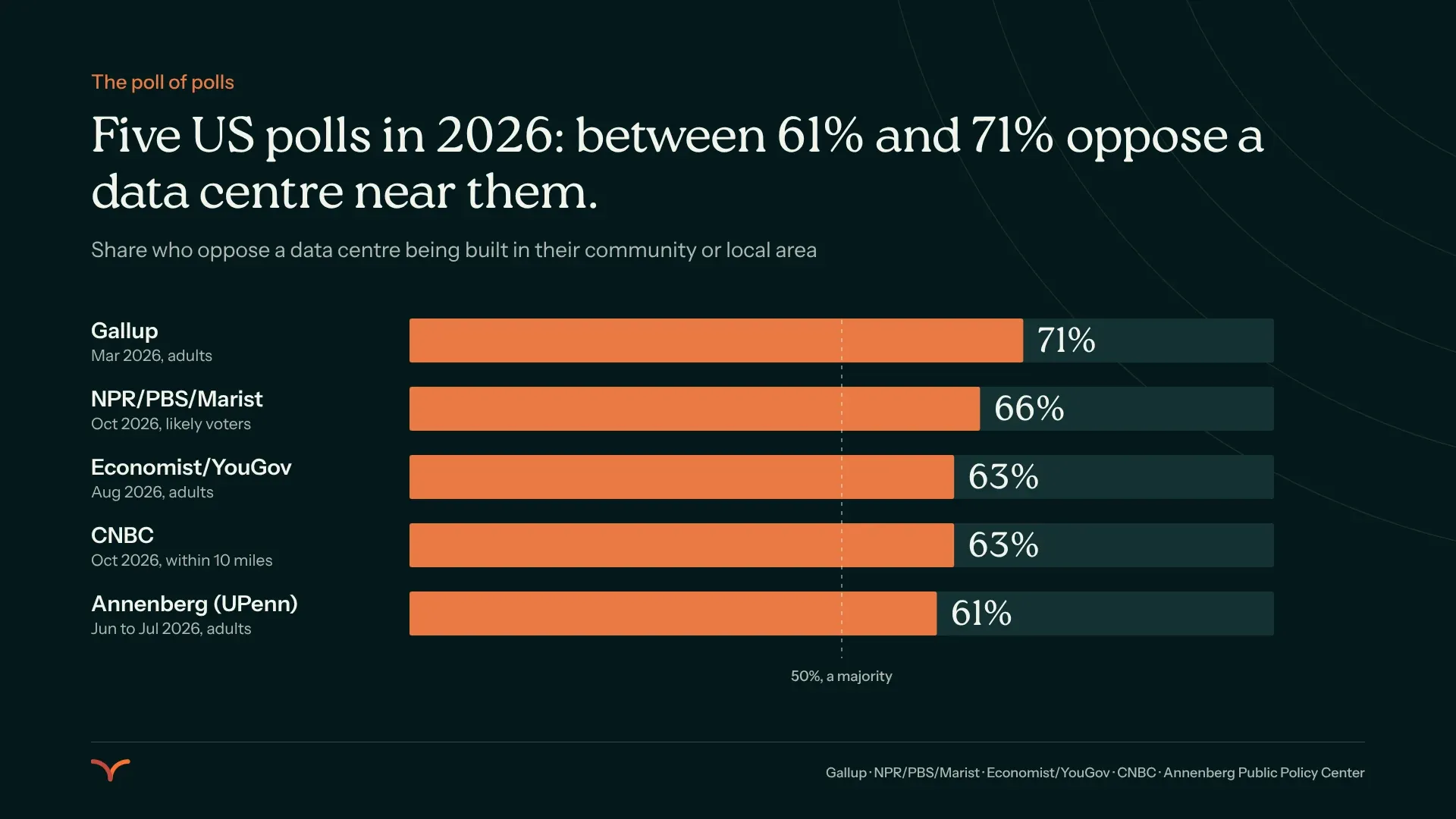
The clearest numbers come from the US, where data centres have become an election issue. In August, the Annenberg Public Policy Center at the University of Pennsylvania published a survey of 1,320 American adults. By July, 61% opposed a data centre being built in their community, up from 49% when the same survey ran in February and March. Support fell from 21% to 14%. Among people under 30, opposition hit 70%.
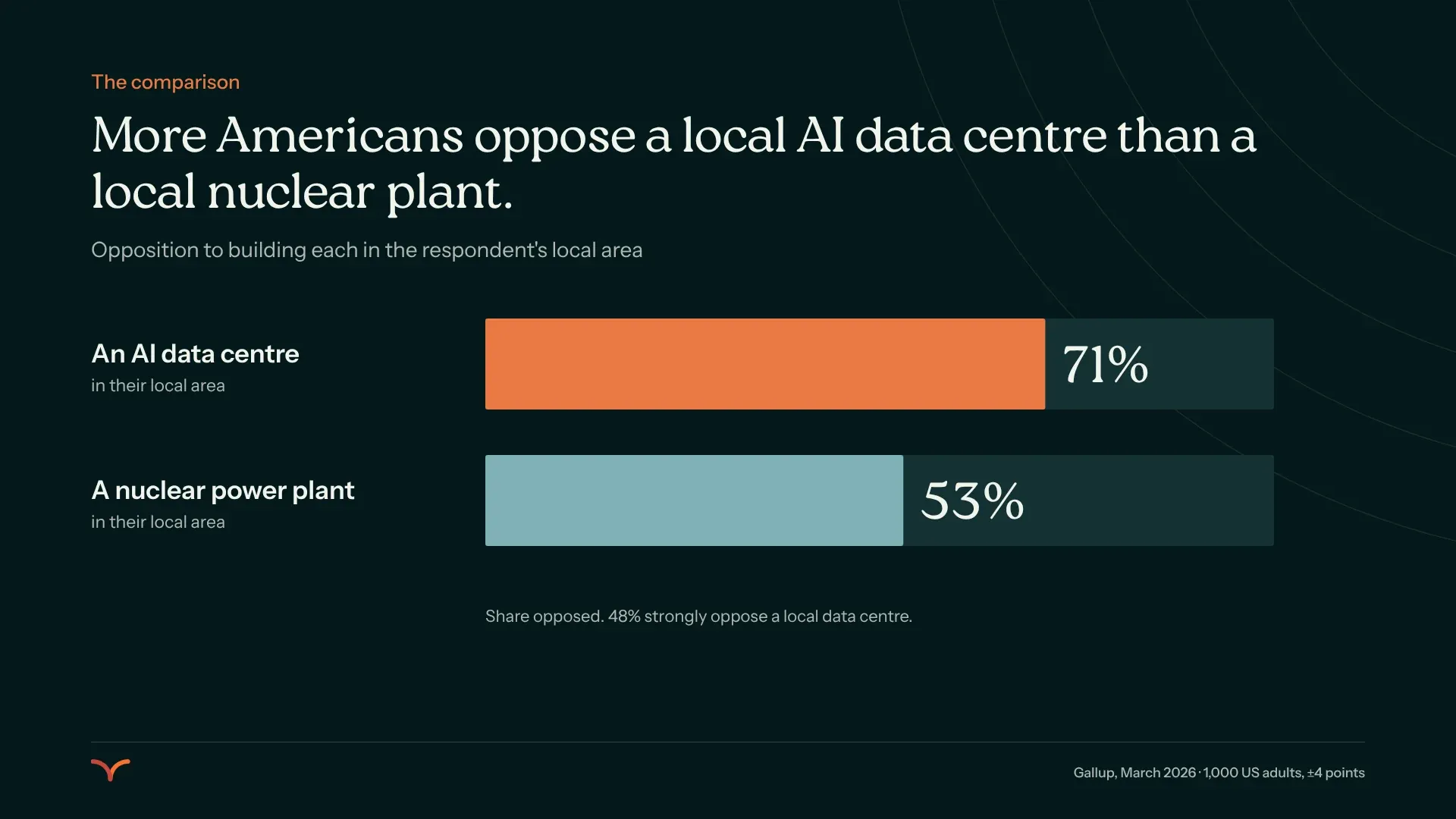
Gallup found the same thing in March, with a twist. 71% of Americans opposed an AI data centre in their area and 48% were strongly opposed. Only 53% opposed a nuclear power plant in the same spot. When Gallup asked opponents why, about half pointed to resource use, with water and energy each named by 18%, and 16% named pollution, noise included.
Every other national poll I could find this year lands in the same range.
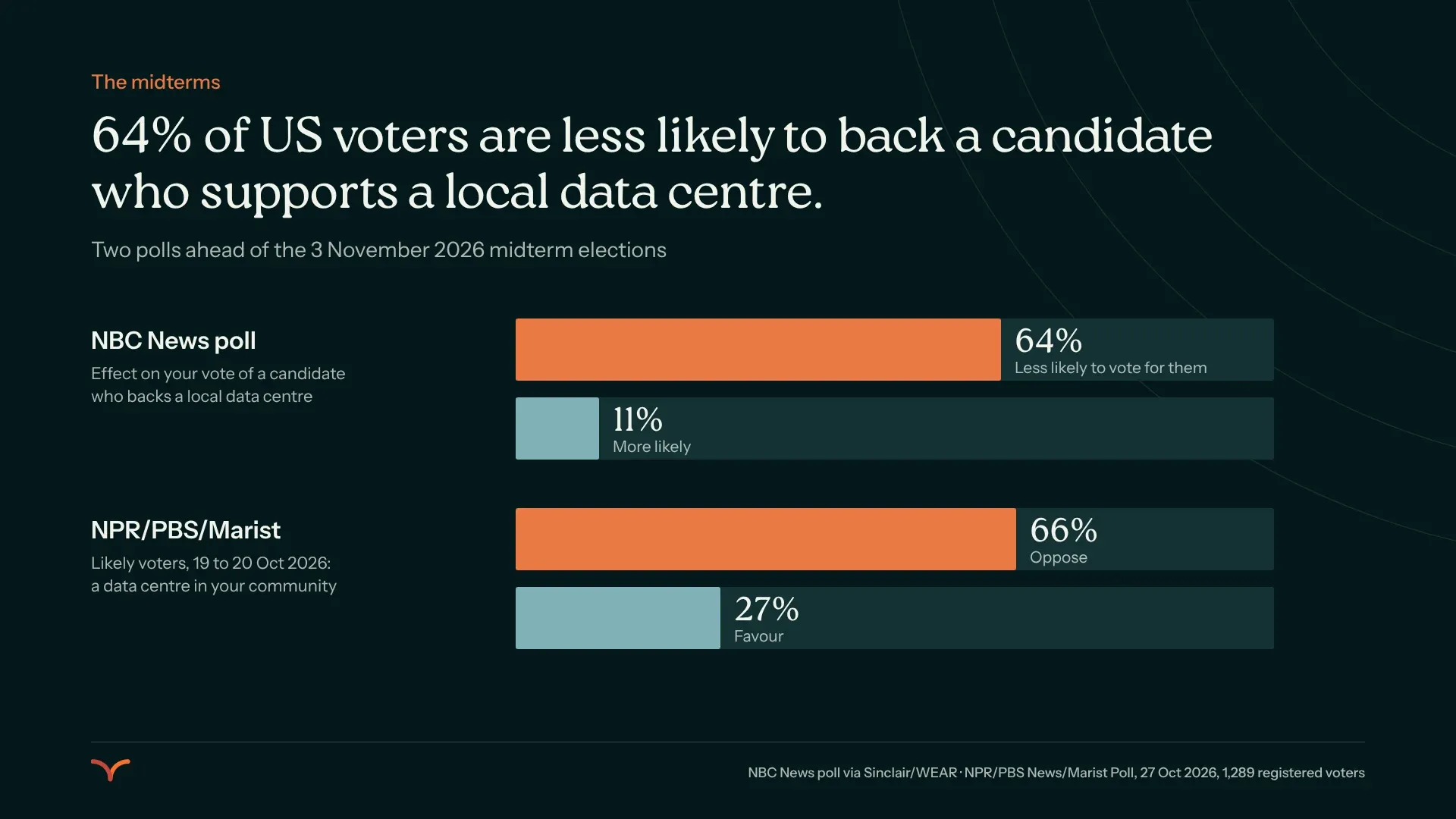
That feeling is now turning into votes. In an NBC News poll, 64% of voters said they'd be less likely to support a candidate who backs building a local data centre, against 11% who'd be more likely. An NPR/PBS/Marist poll taken two weeks before this week's midterms found 66% of likely voters oppose data centres in their own communities, and 59% think the ones tech companies are building are bad for the country. It crosses party lines. Economist/YouGov found 52% of Republicans and 71% of Democrats oppose one locally, and 60% of all Americans expect a local data centre would push up their power bill.
Australia doesn't have polling on this scale yet. Bell Bay suggests we won't need it to know the answer.
Mum, this is what a data centre is
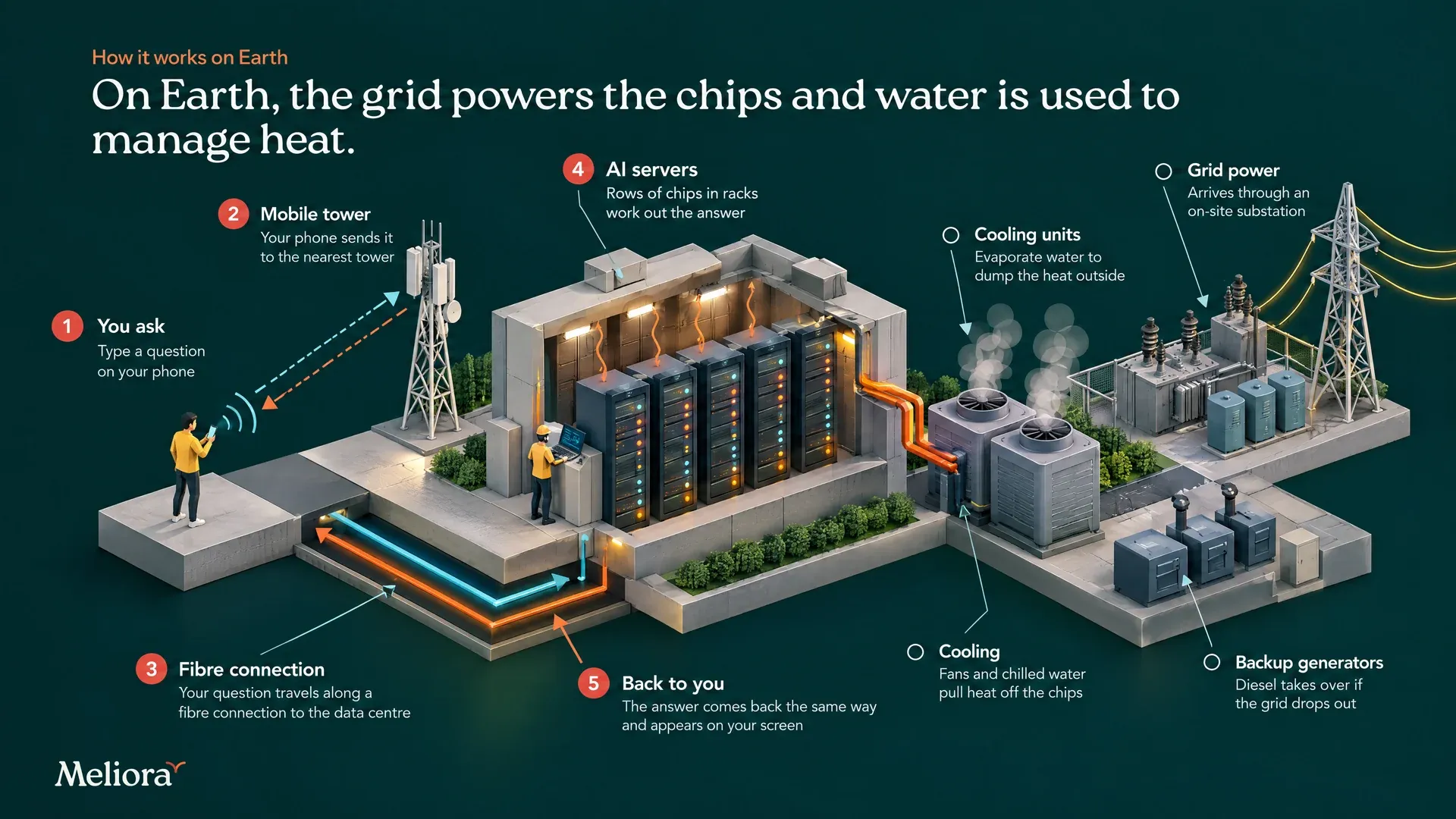
A data centre is a giant shed full of computers. When you ask an AI about your car insurance, your question travels down a cable to one of these sheds, a chip inside works out the answer, and the answer comes back. It takes a few seconds.
The shed needs two things. The first is electricity, and lots of it. In the US, data centres could use up to 12% of the country's power by 2028. The second is cooling. Chips run hot, the way your laptop warms your knees, so fans and water run around the clock to stop them cooking. Many sites cool by evaporating water, so they drink water as well as power.
If the grid drops out, so does the AI, which is why most sites keep diesel generators out the back. So when someone says "the cloud", picture a humming warehouse in a paddock. That's what people are being asked to vote on.
Why the best AI tools launch in America first
In my last piece, Your Next Customer Is a Robot, I wrote about Meta's Muse, the personal AI agent that shops, books and fills in forms for you, and Instinct, the agent you text, which launched invite-only in August and raised US$1 billion at a US$10 billion valuation. Muse launched on 8 September. Anthropic followed on 21 October with Claude Duet, an agent that watches your apps, sends you a morning brief and gets jobs done in the background. If you're reading this in Sydney, good luck getting into any of them. Muse is US-only and Meta hasn't given a date for Asia-Pacific. Duet is a waitlisted preview for US subscribers on Claude's Pro and Max plans. Instinct is still invite-only.
The reason is compute, which is simply the processing power inside those sheds. A chatbot answers you once. An agent like Muse opens a browser, reads pages, compares prices, fills in a form and checks its work, so one errand uses many times the compute of one answer. Every new country an AI company switches on is millions more people asking for that compute at the same moment.
There isn't enough to go around, even for the giants. In June, Google capped how much Meta could use its Gemini models because it couldn't supply the capacity Meta wanted, and Meta told its own staff to use AI more sparingly, according to the Financial Times. The same month, Google agreed to pay SpaceX $920 million a month for access to 110,000 Nvidia chips as "bridge capacity" for its own customers.
Anthropic, the company behind Claude, says the same thing in the paperwork for its share market listing. Its S-1, filed with the US Securities and Exchange Commission last week, names compute as a key risk. It warns that "the market for compute is intensely competitive" and that it competes for it "with some of the world's largest and most well-capitalized technology companies". Electricity is on the list too. An earlier draft showed Anthropic could commit up to US$750 billion to compute in the coming years, including US$111 billion to Google and US$110 billion to Amazon Web Services in contracts it can't cancel. When the company that makes the agent tells investors it can't be sure of the compute to run it, I don't think it's a coincidence that Duet starts in America and nowhere else.
Here's the short version. AI companies have more customers than compute. More compute means more sheds. And the sheds are where the trouble starts.
The neighbours have a point
Data centres hum all night, they look like a distribution centre dropped into a paddock, and in Finland one took out a forest.

Google's Finnish subsidiary cleared about 530 hectares at two sites, Muhos and Otanmäki. That's roughly 1,300 acres and an estimated 400,000 trees, felled before the required environmental assessments were finished. Finland's licensing authority ordered all preparatory work at both sites stopped. Residents of Otanmäki say wolves have started walking into the village because the forest they lived in is gone. Google says it has "fallen short of our own high standards" and will replant 130 hectares at Muhos, less than half of what it cleared there. This is the same company that announced a €13 billion investment in Finland a month earlier.
Closer to home, George Town Council approved Firmus Technologies' 288 MW AI data centre on the old pulp mill site at Bell Bay in August. Residents of Rowella, about a kilometre across the Tamar, have fought it over light, noise and diesel fumes next to vineyards and wedding venues, and their petition passed 6,000 signatures. The council limited generator testing to business hours on weekdays. In September, Firmus appealed to the state tribunal to let it run those generators during grid shortfalls as well. Then in October it abandoned its share market float, which at a hoped-for value of about $44 billion would have been the biggest Australian listing since Telstra. It still has about US$550 million in chip pre-payments due by December.
Then there's Memphis. In April 2025 the Southern Environmental Law Center found xAI running 35 gas turbines to power its Colossus supercomputer when it had applied for permits covering 15. By the group's estimate the site puts out 1,200 to 2,000 tonnes of nitrogen oxides a year, beside neighbourhoods where residents were already reporting breathing problems.
In each of these stories the complaint is about where the machines go, and the people who live next door have noticed.
Why not sink them in the ocean?
The obvious fix for heat is water, and people have tried it. Microsoft ran a sealed data centre the size of a shipping container 117 feet down off the coast of Scotland from 2018 to 2020 and found the idea worked. China now runs a 24 MW underwater facility about six miles off Shanghai and says it uses nearly 23% less power.

I don't think the ocean is the answer. A data centre pushes out heat every minute of every day, and in open water that heat goes straight into an ecosystem. Eric Masanet at UC Santa Barbara says the noise and vibration questions "need serious study", and he compares them with the way ship noise affects whales. We're still learning what shipping lanes have done to whale populations. Scale undersea data centres up to gigawatts and we'd be running that experiment again, on purpose.
So here's my idea. Find an old quarry. Most cities have a worked-out pit that nobody knows what to do with. Line it with concrete, flood it, and lower the data centre into the water. You get the cooling of a lake without a single fish, whale or reef in the way. Water deadens sound, so the hum stays in the hole. The whole thing sits below the skyline on land that was dug up decades ago, so nobody has to clear a forest. The heat stays in a closed body of water you can measure, run through heat exchangers, or pipe to the town next door. Inland nights can drop below freezing in winter, so that waste heat can keep homes warm.
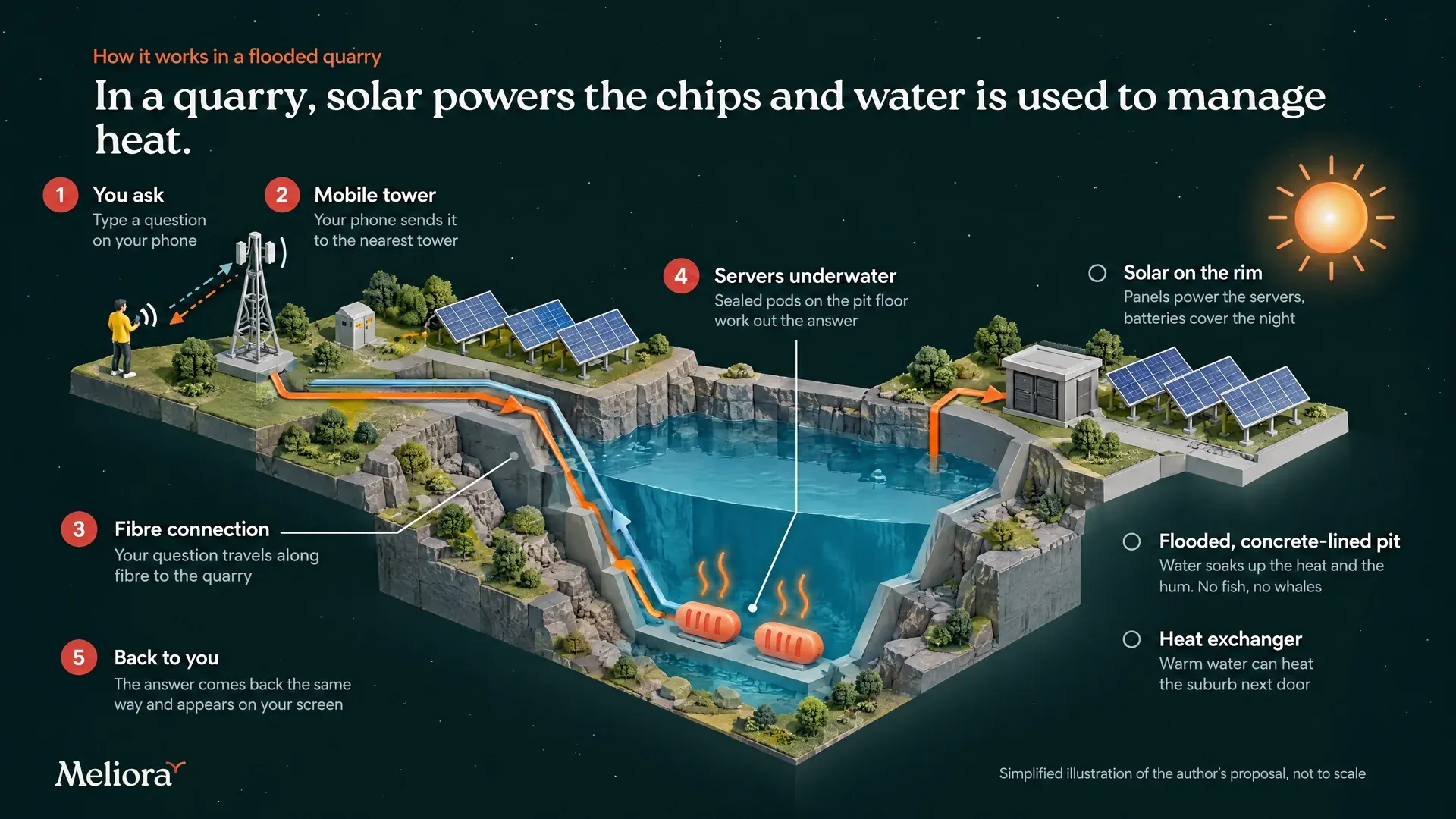
Australia can do this bigger than anyone. The country is dotted with open-cut mines, many of them out where the sun shines almost every day, and Australia gets more solar radiation per square metre than any other continent. Flood a worked-out pit, sink the data centre into it, and cover the land around the rim with solar panels. The power comes from the sky overhead, so the site doesn't have to fight a suburb for a grid connection, and the nearest neighbour is a long drive away. One limit, though: Meliora would oppose putting any of this on Aboriginal and Torres Strait Islander land. Plenty of Australia's mining has happened on Country, and what happens to that land next is for its Traditional Owners to decide.
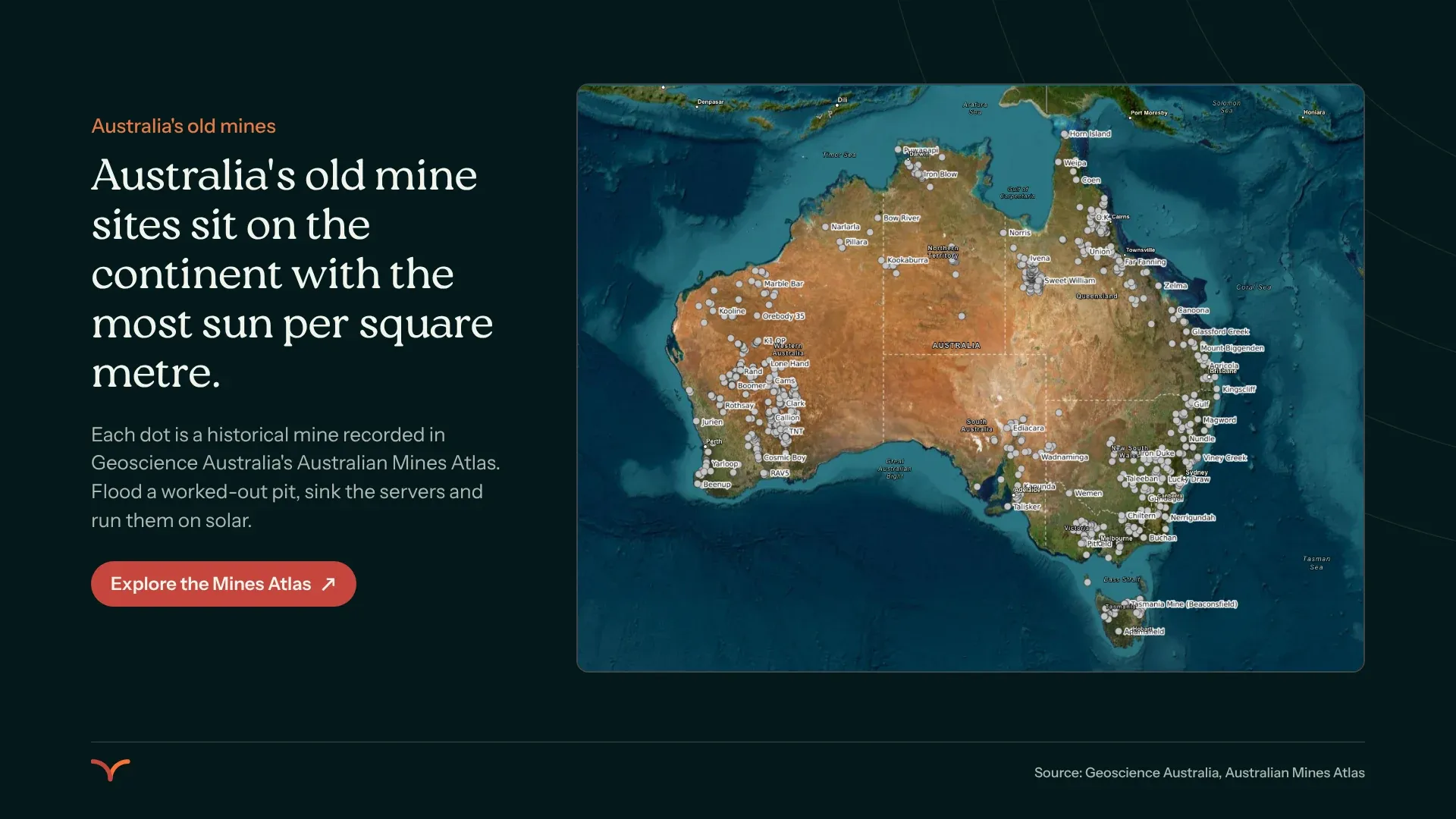
The catch is the night: solar needs batteries or a backup source after dark, and a remote pit needs long fibre runs to reach its customers. In the right orbit the sun barely sets, which is why I still think the long-term answer sits a few hundred kilometres up.
Google, SpaceX and Bezos are already racing to put data centres in orbit
In the right orbit the sun almost never sets, there's no neighbour to object and no grid connection to queue for. The companies that run the biggest clouds on Earth also happen to run, or fund, space programs. I expect the next big jump in compute to come from those programs.
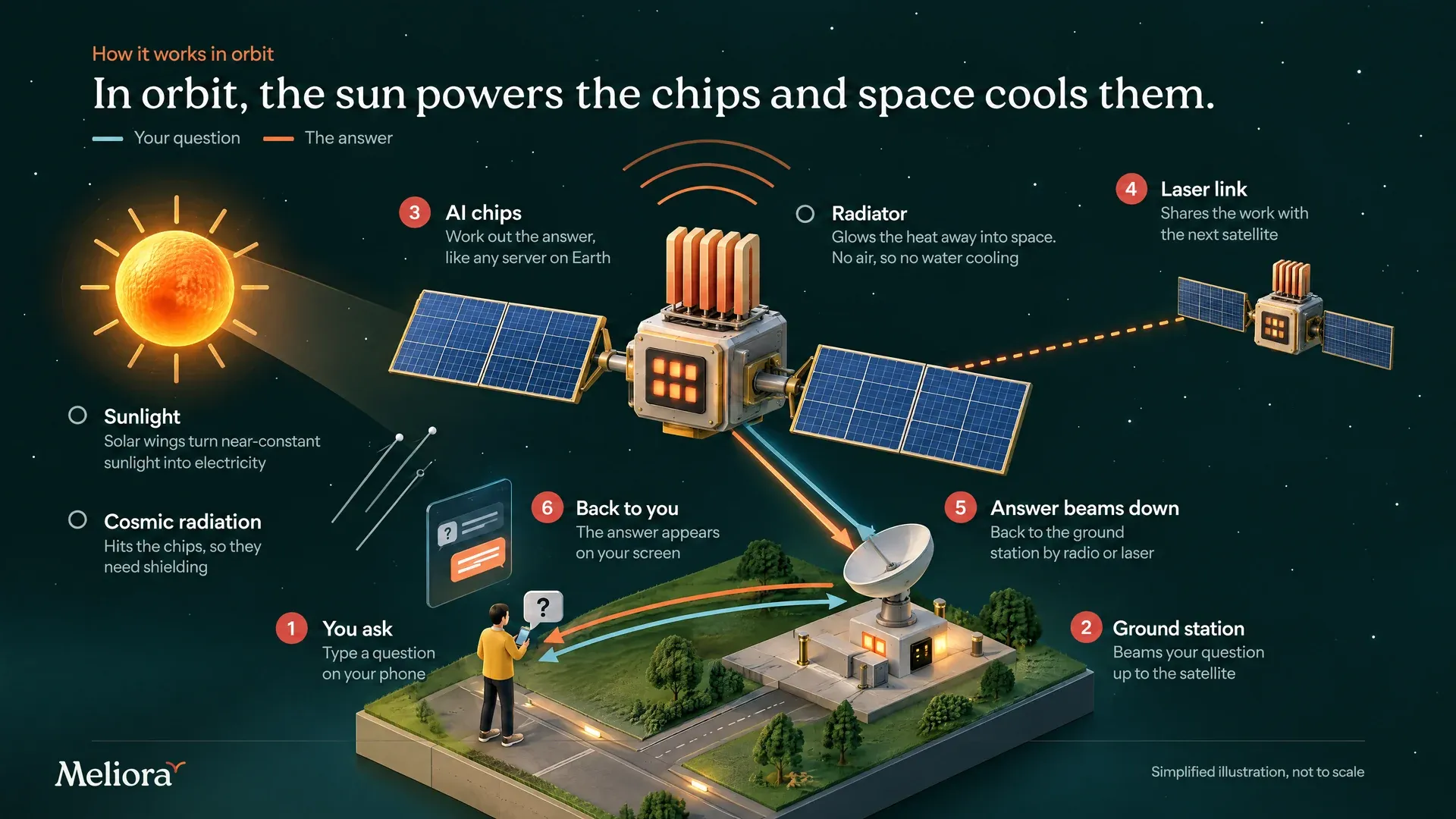
The satellite makes its own power from sunlight and gets rid of heat by radiating it into space, so it needs no grid connection and no water. Your question goes up from a ground station by radio or laser, and the answer comes back down the same way.
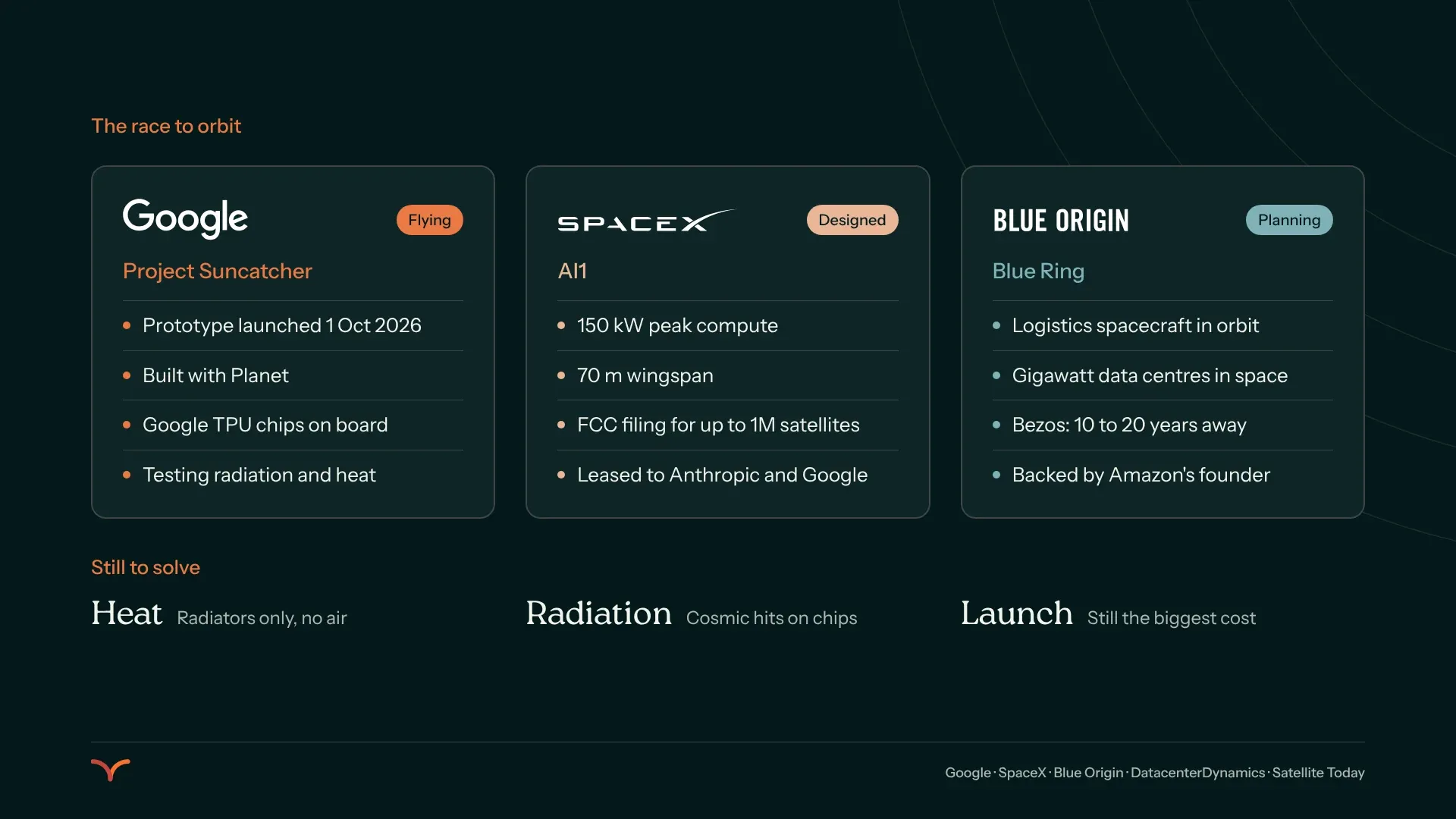
Google is furthest along in public. On 1 October its first Project Suncatcher prototype went up on SpaceX's Transporter-18 rideshare. The satellite was built with Planet and carries Google's own AI chips, called TPUs. Google says it's "operating as expected" and will spend the coming weeks measuring how the chips handle radiation and the swing between baking sun and deep cold. Ground tests had already suggested the chips can survive a five-year mission in low orbit.

SpaceX is thinking bigger. In January it filed with the US Federal Communications Commission for up to a million data centre satellites. It has since described AI1, a satellite with 150 kW of peak compute, a 70-metre wingspan and a 110 square metre radiator, and has reported deals to lease that compute to Anthropic and Google.
Then Amazon's founder. Blue Origin is building Blue Ring, a spacecraft for logistics in orbit, and Jeff Bezos told Italian Tech Week, "we're going to start building these giant gigawatt data centers in space." He gave it "10+ years" and bet on "not more than 20".
There are still hard problems to solve. Space has no air, so heat can only leave by radiating off large panels. Chips take hits from cosmic radiation. Launch is still the biggest single cost. Planet's James Mason puts it plainly: "The challenge with orbital data centers are really power and thermal and doing that economically." He expects small, useful clusters in two to three years and workloads that can compete with Earth-bound sheds in about a decade. That's the timeline I'd plan around.
Orbital tech: three names to remember
Call it orbital tech: the companies building compute, power and networks for orbit instead of for the ground. Most of the money so far has gone to the hyperscalers' own programs, but a handful of operators and suppliers are already flying hardware. These are the three I'm watching.
Starcloud, from Redmond in Washington state, put an Nvidia H100 into orbit in November 2025 and trained a small AI model in space a month later. It raised US$170 million in March and a further US$250 million in August, with Nvidia investing. Why it could be huge: the chipmaker is on its cap table and no other pure play is as far ahead.
Axiom Space is best known for flying private astronauts to the International Space Station. On 11 January it launched its first two orbital data centre nodes, riding on Kepler Communications' laser relay satellites. It plans to grow from kilowatts to megawatts of processing from 2030. The case for Axiom: it already sells to governments, and NTT's Brandon Karpf says sovereign cloud fetches the highest price per unit of compute of any data centre model. Governments that want their data processed off-planet and off anyone else's soil are the first customers who'll pay a premium for it.
Planet, listed in New York, earns over US$300 million a year selling pictures of Earth from its satellite fleet. It built Google's Suncatcher prototype, which went up alongside 18 of its own imaging satellites, and its shares rose 7.8% on the day. Planet and Google plan a bigger compute demonstration on Planet's next-generation satellites in early 2027. Planet's edge is that it knows how to build satellites in volume, and Google is paying it to learn compute. Analysts don't expect a profit before 2029, so it's a patient bet.
Our prediction: whoever owns orbit decides who gets AI
Australia will open its last hyperscale data centre on land before 2035. Every one after that goes orbital.
Here's why that should worry you. Whoever owns the compute decides who gets the AI first, which is why Muse and Duet launch in America and we wait. Move the compute into orbit and that queue gets longer, because today only the US and China are putting it there at scale.
Orbital Sovereignty is about to become the most hotly contested issue in AI, and orbit is where that fight starts. Nobody owns orbit, but under the 1967 Outer Space Treaty every satellite stays under the law of the country that registered it. So a data centre passing over Sydney every 90 minutes or so answers to Washington or Beijing. Can Australia train its own models on rented American or Chinese satellites? Who gets to see that data? And what happens to our access the day one of those governments decides we shouldn't have it? If Australia sits this out, we'll rent our AI from someone else's satellites, on their terms, after their own people are served.
The good news is that Australia starts this race with more than most. We have the sun and the open land, launch sites in the Northern Territory and Queensland, and decades of experience running ground stations for NASA and the European Space Agency. Get the next ten years right and the AI that words your kid's party invitation could run on Australian satellites under Australian law, and nobody would have to give up a paddock for it. That's worth building.